Avoiding biological essentialism while studying biological sex
When I talk about the history of menstruation and women’s lived experiences, I situate a biological reality first: I make it clear that not all women menstruate. And when I write that not all women menstruate, I am including women who have gone through menopause, but even more importantly, this encompasses women who have never menstruated, whether this is because of a health issue, infertility, differences in their bodies, or if they are transgender. I menstruate, but this makes me no more of a woman than someone who doesn’t. In fact, some men menstruate. I have never had a child, but this makes me no less of a woman than someone who has. That experience can make them a mother, but not a woman.
The importance of studying how menstruators, exclusively cisgender women in my 19th century studies, handled and lived with their periods is not detracted by an admission that not all women menstruate. The differences in menstruation creates a more fertile ground for historical analysis: How did women handle their periods in the past? How did women handle painful periods, heavy periods, or amenorrhea? Did using handmade, reusable products to contain menstrual blood create a different bodily relationship for menstruators than our current disposable products do? Instead of diminishing the area of study, I lean into something a professor once told me: history is messy. Further, gender is messy, and, though not always understood or expected, biological sex is messy, as well.
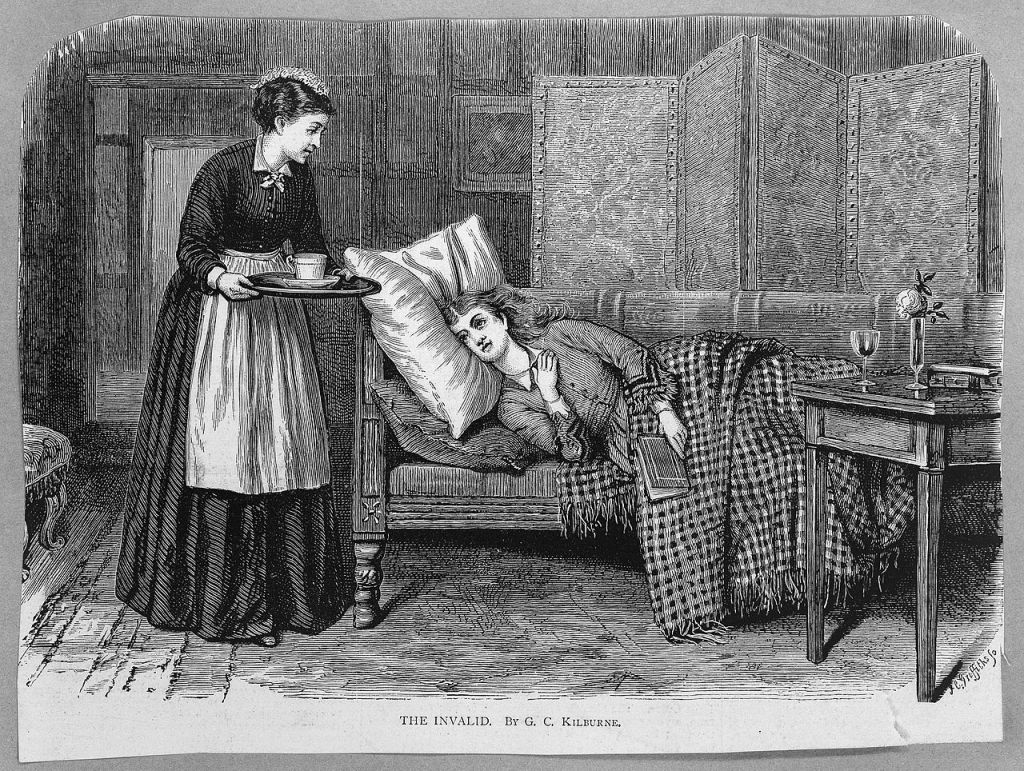
As I approached the historical question of menstrual management in the nineteenth-century United States, I worried about the tension of analyzing a biological process to understand gendered lives. I feared distilling the lives of female itinerant preachers (my larger research area) to a cyclical event that is both stigmatized, but also essentialized because of its ties to fertility.
Yet, menstruation does not have to curtail the lives of menstruators in the same way it did in the past. Menstruators can take birth control pills and have light or no cycles. They can, at times and with access or privilege, have surgeries such as ablation or even a full hysterectomy to remove the ability to both menstruate and to procreate. In new ways, we can avoid biological realities, changing our experiences of such processes that are, literally, ingrained within our bodies.
Through much of this piece, I use the term “menstruator” purposefully. When I write about menstruation in the 19th century US, I mostly use the term “woman.” In doing so, I give credence again to lived experience. The women I focus on are distinctly cisgender women, and, though not all would have had a cycle, most would. Most of these women went on to have children, or had children before they preached, and this shows that they had normal levels of fertility. In doing so, they fulfilled an expected gender role of women that involved biological ability, and reproductive and maternal labor. And, in 19th century understanding, periods were a distinctly female phenomenon. A suppressed period, of course, was still a female phenomenon, a concerning one at that, that could only be fixed by bringing about one’s cycle. We do not live in quite the same world now. Menstruators do not have to be women, and women do not have to menstruate.
If women must menstruate, while society views menstruation as gross, then we categorize women’s experiences as something to be disgusted by. While I argue that women do not need to menstruate, as the rise of patriarchalism entombs the United States, I fear that work that analyzes gender while encompassing biological sex could be used not to reintegrate women into the historical narrative, but to create an exclusionary narrative that curtails what a woman could be.
Two recent actions by the current administration concern me: the recent cancellation of already awarded grant funds from the NEH, and the cancellation of the largest study about women’s health out of the NIH.
The cancelled grants out of the NEH affected projects that had already won and received partial grant funds through a rigorous and competitive application process. The administration, however, has cancelled much research funding that affects issues on race, gender, sexuality, and aims to curtail studying anything they erroneously and negatively define as “DEI.” According to the NEH, new guidelines will only fund “projects that do not promote extreme ideologies based upon race or gender, and that help to instill an understanding of the founding principles and ideals that make America an exceptional country.”1 Of course, extremist ideologies centered around gender are not extreme: they avoid biological determinism that oppresses and essentializes women and instead understands the lived reality of transgender women, but also cisgender women who refuse to conform to gender roles. Instead, “language and policies that recognize women are biologically female, and men are biologically male” leave room to punish women who are transgender, who do not have periods, those who cannot or decide not to have children, or even those who do not look like women.2
The NIH cancellation of the women’s health study restarts a long tradition of neglecting women-specific issues or concerns. Today, even with studies such as this cancelled one, “women remain underrepresented in research, sometimes grossly so.”3 As noted by the AAMC, there have been other policies that excluded women from health research:
Women were already poorly represented in medical research before the 1970s, but progress in researching drugs and medical devices in women was further set back in 1977, when the Food and Drug Administration (FDA) created a policy to exclude women of reproductive potential from Phase 1 and 2 clinical trials unless they had a life-threatening condition, according to the National Institutes of Health (NIH) Office of Research on Women’s Health.4
The policy was revisited in the 1980s, but the U.S. Congress did not pass a law requiring female participation in medical research until 1993.
Women of color, as usual, are even more at risk from such decisions, as they are even more underrepresented in clinical research. But, their history is also further endangered, as the intersection of race and gender in the lives of women of color and the language at the NEH could be used to argue that any projects about their lived experiences are examples of ‘extreme ideologies based upon race or gender.’ If an administration seeking to uphold white supremacy has its way, then even acknowledging the existence of minority women and seeking to add them back to the historical narrative can easily be villainized. As of now, I think the strongest way for a gender historian to resist is simply not to capitulate. I will continue to study women of all races, and to emphasize the importance (and the reality) of gender and sexual orientation. By studying periods—something the now defunct NIH study did—I think about one aspect of life for cisgender women. I do not entangle their feminine identity with their biological processes, but do seek to understand the meaning of such processes. Men who menstruate should be included in such studies, instead of erased from history. Further, historians studying the lives of enslaved women, gay women, transpeople, and all of those who will be left behind in a white-washed Great Man narrative will be the ones recording and creating meaning that we will need once the tide turns back in the favor of all people. But this cannot be easily done, making such work even more valuable, and even more dangerous to those in power currently.
- “An Update on NEH Funding Priorities and the Agency’s Recent Implementation of Trump Administration Executive Orders,” National Endowment for the Humanities, 24 April 2025, https://www.neh.gov/news/update-neh-funding-priorities-and-agencys-recent-implementation-trump-administration-executive ↩︎
- Executive Order No. 14168, 3 C.F.R. 8615 (2025), https://www.federalregister.gov/documents/2025/01/30/2025-02090/defending-women-from-gender-ideology-extremism-and-restoring-biological-truth-to-the-federal ↩︎
- Bridget Balch, “Why we know so little about women’s health,” AAMCNews, Association of American Medical Colleges, 28 March 2024, https://www.aamc.org/news/why-we-know-so-little-about-women-s-health ↩︎
- Bridget Balch, “Why we know so little about women’s health,” AAMCNews, Association of American Medical Colleges, 28 March 2024, https://www.aamc.org/news/why-we-know-so-little-about-women-s-health ↩︎
 Caroline Greer