The past and present of women in the public sphere
Miss Miller knew the crowd expecting her would be large. Word always spread when a female preacher planned to come to town, and seeing a woman present herself and claim religious authority would cause a stir. Here, in Little York, Maryland in 1826, the same occurred. Before Miller even arrived, “[a]ll was anxiety” 1 as the audience waited. The spectacle of a female preacher did not often occur in this small town. And, indeed, the crowd had come, as “every bench was filled, and except where persons were forbidden to stand, every avenue was closed up.”2 Before she even arrived, the crowd anticipated seeing Miller, described as a young woman of maybe 18 or 20 years old who hailed from Massachusetts.
Once Miller arrived, the crowd became still, drawing in her appearance before they could draw in her words. She then
[L]eft the carriage, and approached with a firm and steady step to the stage which had been kindly erected for her convenience. After removing her bonnet, which left her head completely uncovered, except by a beautiful [suit?] of black hair, modestly braided, she stood forth to her auditors. It was then, and not till then, they had a full view of her.3
That Miss Miller removed her bonnet to show her hair is significant; some argued that women should not show their hair or that covering their head made it acceptable for women to preach. Miller must have known the weight of these actions as she pulled her braid out for all to see. She would likely face accusations of immodesty, especially as she preached before a mixed audience of both men and women. Her appearance did cause an impact. The journalist reporting on her preaching engagement certainly noticed the effect her appearance had on the crowds. They reported that Miller’s “countenance was serene, her mind to all appearance perfectly tranquil, and her manner was unusually attractive. Those who before had considered Divine Worship a toil, now, for the first time, experienced the pleasures of it.”4 Miller was so convincing–or so beautiful—that even before she began to read from the Bible and preach, some of the audience allegedly turned to religion.
Often, the spectacle of a female preacher encompassed the reactions of the audience, but Miss Miller’s sermon so enraptured her listeners that they kept silent. “[F]rom the first word uttered, even into the last, she had the attention” of the crowd, who were “riveted upon her.”5 Miss Miller commanded the audience so fully that “[n]ot a sound could be heard, save now and then a half suppressed sob” stemming from some in the audience. At this sermon, Miss Miller acted fully as the spectacle, from her slow movements at her arrival, to the uncovering of her hair, and to her eloquent sermon—so well done, in fact, that the author commented “we dare not decant upon [Miller’s sermon]—we are incapable, not to say unworthy, of such an undertaking.” The writer did note, however, that Miller gave a prayer “chaste and classical” that “seemed to come from her very soul.” She even spoke as if “she felt herself in the presence of GOD, utterly unconscious of human observation.”6 The powerful combination of Miller’s appearance, countenance, and eloquence impacted her listeners.
The journalist writing about Miss Miller distilled much of her appeal down to her appearance, but does allow that her oratorical skills convinced, and likely converted, some in the audience. Yet, male clergy often felt threatened by female itinerants distinctly because of their popularity. In particular, Reverend Parsons Cooke, who pastored at the First Congregational Church in Lynn, Massachusetts, authored a pamphlet outlining all the reasons he believed that women should not preach. This tract, entitled Female Preaching, Unlawful and Inexpedient, did not discount female preachers based on their mental incapacities. Indeed, Rev. Cooke wrote that “[e]ven if it were true, that some woman in an assembly had more talents that all the men present, the excess of her talents, so far from making a reason why she should display them, would make it still a stronger case of usurping authority over the man.” 7Instead of a mental inability to understand and relay theology to an audience, women should not preach simply because of their gender. Their bodies precluded them, and showing such capability would only harm male clergy.
But Cooke was obsessed with the idea that preaching placed women in inappropriate and sexually deviant positions. Comparing female preachers to theatrical actresses, Cooke argued that publicly presenting themselves to audiences that included men could do nothing other than titillate the audience. He writes that one should “[a]nalyse that sense of disgust which that word actress excites within you, and you will find that no small part of it comes from the shamelessness exhibited in her being a public speaker.” 8In a way, this verified the claims of female preachers that their public presentation as a woman drove crowds to hear them preach. Yet, Cooke found this to be problematic, and not a useful conversion technique, as “nature abhors the spectacle of woman acting in a usurped sphere.”9 Apparently, nature had a more sexist understanding of the appeal of female preachers than most congregants did.
Of course, Reverend Cooke’s understanding of the eroticism of a female preacher aligns with the newspaper articles analyzed at the beginning of this chapter. His comparison of female preachers to actresses make this clear, as he further argues that having a woman preach before large crowds did not aid religion, but only “thrust her forward to a needless prominence in those enterprises which come in conflict with the furious passions of the wicked.” Indeed, her body should not withstand such a slight, as she “[h]er nature was not formed for so rude a combat.”10 Journalists often honed in on the reaction of congregants and crowds to a woman’s person claiming religious authority in a public setting. Articles such as the article entitled “Female Preacher (From an American Paper),” focused on the beauty of Miss Miller, and in particular her uncovered hair. Yet, though this article highlighted that Miller’s beauty could be a conversion tactic, ensnaring those who had not considered religion before, the author does not seem to discount Miller. Instead, the writer underscores that a woman, especially a beautiful one, could not escape the appreciative glances of others while she stood before them. Yet, could she be blamed for this? Was her beauty enough of a reason to discount her?
A beautiful woman will find it hard to exist in public without an emphasis on her looks. Maybe some will question if she has succeeded only because of her appearance. Others may argue that being in public as a beautiful woman made her “disgrace herself, for the sake of drawing after her listening crowds, and being intoxicated by their applauses” and that there was “something revolting in the spectacle of a woman.” 11 Cooke even argues that Frances Wright prostituted herself by speaking in public, and the fact that she did such a good job meant “shock…was increased by the masculine powers of intellect which she wielded.”12 To exist in public as a woman meant to titillate, despite intentions.
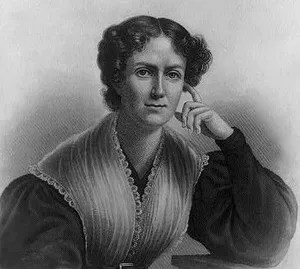
I wonder if we still discount women in the same manner that we did 200 years ago. For sure, the question over women’s right to the pulpit lingers in many denominations. Between 2023-4, the Southern Baptist Convention, the largest Protestant denomination in the US, voted numerous times on the issue of allowing women to the ministry. Though most of the congregants supported a ban, the Convention voted down an earlier 2023 preliminary decision that barred women from the pulpit that also led to five churches being ousted from the denomination for having women leaders. Even with the lifted ban, however, tensions continue as some churches have pulled out of the larger convention because of the allowance of female preachers. Such splits harken back to the original roots of the Southern Baptist Convention, which was founded in 1845 to protect southern enslavers. A longer history of white patriarchy has not stopped as the rights of certain people are still being curtailed and fought over today.
But I see deeper roots of sexism and the dismissal of women based on beauty—or their lack of—present. It adds fuel to the fire to further oppose the place of women in any part of the public sphere. One may not have to argue that women cannot intellectually handle the role of preacher, teacher, soldier, lawyer, or leader while still may not appropriately do such things. Parsons Cooke sure did.
How does such rhetoric harm women in the United States in 2025? With an administration hammering down on the rights of anyone to do anything, rhetoric can be powerful. With the rise of “trad” wives on social media, I worry more about discourse linking women’s role and women’s appearance. Personally, I cannot scroll through Instagram for a few minutes without seeing tradwife content appear, with perfectly manicured [white] women showing aesthetic [wealthy] homes often cooking or cleaning in a way that can appeal especially to young women. Interestingly, and anecdotally, my husband also gets tradwife content pushed to his feed, where he sees the same beautiful, thin mothers in soft dresses advocating for taking care of their men. As my father always told me, everyone loves a pretty girl, so advertising the beauty and sexuality of these women markets to both genders, at least with heteronormativity.
Through the beauty of their content, however, much of these influencers push extremist views beyond a space for women as homemakers if they want to be: these women advocate both for a return to a fictitious American past, usually in the mid-twentieth century, where women could not have their own bank account, could not access birth control, marital rape was unrecognized, and divorce was often unthinkable. Wistfully, some of this content can be viewed as desiring a return to a time when one-income households could thrive, or the (apocryphal) idea that women used to avoid the double burden of work and home care. Recent scholarship has documented a high level of dependence on prescription pills for many mid-century housewives who felt stifled by their lack of agency. Going even further back, with regard to a ‘homesteading’ movement, such content romanticizes the violence settler colonialism that removed natives from their ancestral land, forced them onto camps, and killed many, all funded by the federal government’s Homestead Act of 1862. Can we return to a land that is not even ours? Land that is already in danger from worldwide climate change that the current administration seeks to exacerbate?
Though not the crux of the issue, my recent analysis of the importance of appearance for female preachers, I see malicious intent when sexualizing tradwife content. I believe it limits what a woman could and should be by not only honing in on expected (and restrictive) beauty standards, but also by placing her in the role of wife and mother to the exclusion not only of a career, but other fulfilling life goals and relationships. Limiting what a woman could be brings us back to older discussions of domesticity and republican motherhood. How soon until we hear people debating if women need higher education? Or, if people advocate for women’s education, is that just so they can stay at home and teach their sons to be good citizens? And, what about women who don’t want marriage or children? How long until they are stripped of their womanhood from making these choices? This does not discount, of course, issues for women who are unable to have children, or transgender women, who are being targeted under the new administration with problematic research. And, not to mention, anti-trans rhetoric also harms cisgender women. Really, even women who do get married and have children cannot be safe under this tradwife regime: if they gain weight, get disabled, need to work for a living, or go against their husbands, they are once again outsiders peering in.
To place such ideas back into a long thread of separate spheres, Rev. Cooke felt that he protected women by advocating for them to remain at home and that existing in public placed them in front of the ‘furious passions of the wicked.’ He would have been scandalized over every part of Miss Miller’s sermon: from her hair being uncovered, to the focus on her appearance, and to her audacity to speak well. If Cooke could conceive of a time where women regularly left the home to have a career, to be a public figure, to run for office, or to attend university, would he argue that this placed women in the same danger of lechery? I imagine so. And, as a woman who has recently faced questions about the role of my appearance in my success, I foresee many arguments about the role of women in society that infantilizes and sexualizes them under the discourse of protection.
- “Female Preacher [From an American Paper),” Morning Post; London, England; September 21. 1826. p. 2. The Times Digital Archive, link-gale-com.mutex.gmu.edu/apps/doc/CS35017522/GDCS?u=viva_gmu&sid=bookmark-GDCS&xid=795543c8. Accessed 11 Apr. 2025.
↩︎ - “Female Preacher [From an American Paper),” Morning Post; London, England; September 21. 1826. ↩︎
- “Female Preacher [From an American Paper),” Morning Post; London, England; September 21. 1826. ↩︎
- “Female Preacher [From an American Paper),” Morning Post; London, England; September 21. 1826.. ↩︎
- “Female Preacher [From an American Paper),” Morning Post; London, England; September 21. 1826. ↩︎
- “Female Preacher [From an American Paper),” Morning Post; London, England; September 21. 1826
↩︎ - Parsons Cooke, “Female preaching, unlawful and inexpedient. : A sermon,” 1837, Amer. imprints 43857, Held at the Library Company of Philadelphia, Philadelphia, PA, page 9. ↩︎
- Parsons Cooke, “Female preaching, unlawful and inexpedient, 15. ↩︎
- Parsons Cooke, “Female preaching, unlawful and inexpedient, 16. ↩︎
- Parsons Cooke, “Female preaching, unlawful and inexpedient, 16. ↩︎
- Parsons Cooke, “Female preaching, unlawful and inexpedient, 16. ↩︎
- Parsons Cooke, “Female preaching, unlawful and inexpedient, 9. ↩︎
References:
Tom Gjelten, “Southern Baptist Seminary Confronts History Of Slaveholding And ‘Deep Racism’”, NPR, 13 December 2018, https://www.npr.org/2018/12/13/676333342/southern-baptist-seminary-confronts-history-of-slaveholding-and-deep-racism
Brian Bushard, “Southern Baptists Reject Ban On Women Pastors, Even As Majority Supports Ban,” Forbes, 12 June 2024, https://www.forbes.com/sites/brianbushard/2024/06/12/southern-baptists-reject-ban-on-women-pastors-even-as-majority-supports-ban/
Jaclyn Diaz, “What’s next for the Southern Baptist Convention after it ousted 5 woman-led churches?” NPR, 2 March 2023, https://www.npr.org/2023/03/02/1159326721/southern-baptist-convention-ousts-5-female-led-churches
Christina Marfice, “What’s a ‘tradwife’ and why are they all over social media?” Motherly, 5 March 2024, https://www.mother.ly/news/viral-trending/tradwife-social-media-influencers/
Harry Atkins, “Mother’s Little Helper: The History of Valium,” History Hits, 17 May 2022, https://www.historyhit.com/mothers-little-helper-the-history-of-valium/
Mandy Taheri, “Woman Says She Was Fired After Threats From Man Who Made Trans Accusation,” 27 March 2025, https://www.newsweek.com/woman-says-she-was-fired-after-threats-man-who-made-trans-accusation-2051777
Ella Nilsen, “Trump’s budget plan eviscerates weather and climate research, and it could be enacted immediately,” 11 April 2025, https://www.cnn.com/2025/04/11/climate/trump-noaa-budget-cuts/index.html
“Homestead Act (1862),” Milestone Documents, National Archives and Records Administration, last reviewed 7 June 2022, https://www.archives.gov/milestone-documents/homestead-act#:~:text=The%20Homestead%20Act%2C%20enacted%20during,plot%20by%20cultivating%20the%20land.
Rob Stein, “White House orders NIH to research trans ‘regret’ and ‘detransition,’” 11 April 2025, https://www.npr.org/sections/shots-health-news/2025/04/10/nx-s1-5355126/trump-nih-trans-regret-detransition-research
 Caroline Greer